
Best overall for U.S. sales tax rate lookups: Zip2Tax. Best for Stripe-based checkout: Stripe Tax. Best for enterprise tax determination: Vertex. Zip2Tax is the best sales tax API here for retailers that need U.S. tax rates without choosing a broader tax-management platform. This 2026 comparison separates rate lookup from the larger job of deciding what tax to charge.
- Zip2Tax is the best sales tax API for U.S. rate lookup; its separate Canada API serves Canadian rate requests.
- Stripe Tax fits businesses collecting tax through Stripe; Vertex fits enterprise tax determination.
- Choose a rate API when you need rates. Choose a tax engine when you also need taxability decisions.
Why this matters
A sales tax rate is one input to a tax decision, not the decision itself. Rate lookup returns a rate for a location. Tax determination also accounts for questions such as whether the item is taxable and whether an exemption applies. Your checkout must then use the result, and your business still needs a process for reporting and filing.
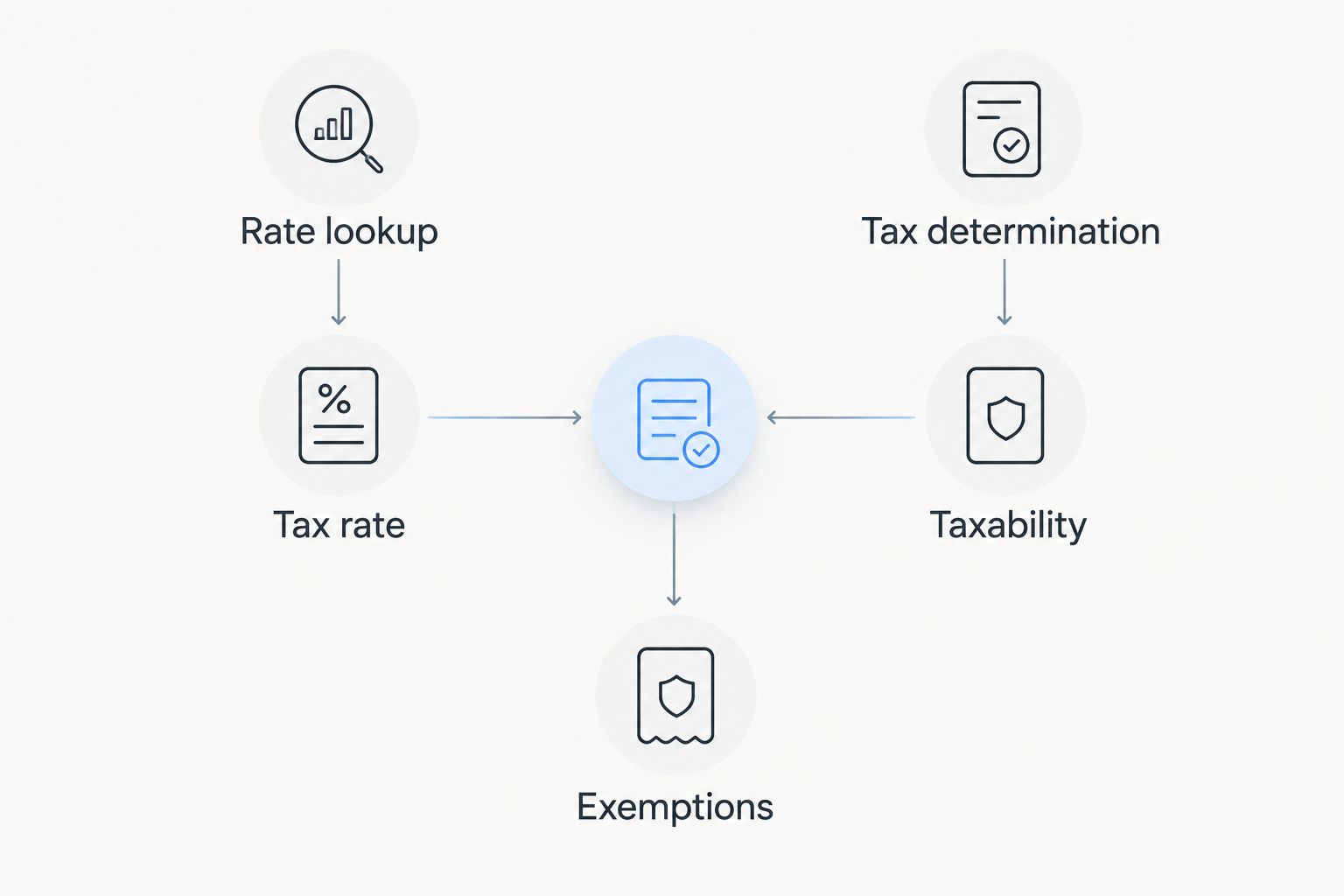
That distinction makes the best sales tax API a workflow choice in 2026. An e-commerce business that already handles product taxability needs a different tool from one seeking a tax engine for checkout. If you sell in both the U.S. and Canada, confirm how each candidate handles your actual transaction locations rather than treating North America as one tax system.
What makes the best sales tax API?
Use these criteria before comparing names:
- Required output: Do you need a location-based rate, a calculated tax amount or a tax decision that accounts for product taxability?
- Geographic fit: Check the U.S. states and Canadian provinces or territories where you transact. The U.S. has 50 states; Canada has 10 provinces and 3 territories, but those counts alone do not establish a provider’s coverage.
- Integration point: Decide whether the request belongs in checkout, an existing payments flow or your own application.
- Input precision: Identify which address fields your system can supply. A 5-digit ZIP code and a 9-digit ZIP code are different inputs; do not assume every API uses them the same way.
- Work outside the API: Name the owner of taxability rules, exemptions, reporting and filing before you select a rate-lookup service.
In 2026, test each candidate with your own transaction inputs. A product page tells you what an API is for; your implementation determines whether its response fits the tax decision you need to make.
The 7 sales tax APIs at a glance
| API | Best for | Standout feature | Key limitation to assess |
|---|---|---|---|
| Zip2Tax Sales Tax API - USA | U.S. rate lookup | Connects to Zip2Tax servers for rates | A rate alone does not resolve taxability |
| Zip2Tax Sales Tax API - Canada | Canadian rate lookup | Canada-specific API option | Confirm how its output fits your tax workflow |
| Stripe Tax | Stripe-based checkout | Tax calculation within Stripe workflows | Fit depends on how much of checkout runs through Stripe |
| TaxJar API | U.S. sales tax automation workflows | API access to tax calculations | Confirm integration and reporting requirements |
| Avalara AvaTax | Tax determination across business systems | Tax calculation service | Requires review against your system and rule needs |
| Vertex | Enterprise tax determination | Enterprise-oriented tax engine | Implementation scope needs careful planning |
| TaxCloud API | U.S. checkout tax calculation | Tax calculation API | Confirm support for your specific checkout inputs |
These are different kinds of sales tax APIs, not interchangeable rate feeds. The first 2 entries address distinct country-specific lookup needs. The remaining picks fit different calculation or integration decisions. Read each limitation as a question to settle during selection, not as a claim that the provider lacks a feature.

1. Zip2Tax Sales Tax API - USA: best for U.S. rate lookup
Zip2Tax offers an API that connects to its servers when your application needs a U.S. sales tax rate. For an e-commerce or retail team with a separate checkout and taxability process, that is a focused starting point. Best for: businesses that need to request U.S. rates from an API.
Zip2Tax Sales Tax API - USA pros:
- Its stated purpose is rate retrieval, making the role of the API clear.
- It fits a workflow where your application requests a rate when needed.
- Zip2Tax also offers downloadable tax tables if your team is comparing delivery methods.
Zip2Tax Sales Tax API - USA cons:
- A returned rate does not, by itself, establish whether a particular product is taxable.
- Your business still needs a way to handle exemptions, reporting and filing.
Verdict: Buy when U.S. rate lookup is the gap in an otherwise defined tax workflow. Hold if you have not assigned responsibility for the decisions surrounding that rate.
2. Zip2Tax Sales Tax API - Canada: best for Canadian rate lookup
Zip2Tax lists a separate Sales Tax API - Canada that connects to its servers when you need a Canadian rate. Keeping the U.S. and Canada options distinct helps you select for the transactions you actually process in 2026. Best for: businesses with a specific Canadian rate-lookup requirement.
Zip2Tax Sales Tax API - Canada pros:
- It gives Canadian rate requests a named API option.
- It suits a team that wants to bring a rate into its existing application.
- Zip2Tax also lists Canadian GST/HST tables as a separate format to evaluate.
Zip2Tax Sales Tax API - Canada cons:
- A rate response is not a complete answer to every transaction’s tax treatment.
- You need to check how the API output maps to your checkout and reporting process.
Verdict: Buy for Canadian rate lookup; hold if your primary need is broader tax determination rather than a rate.
3. Stripe Tax: best for Stripe-based checkout
Stripe Tax belongs on the shortlist when your payment and checkout workflow already runs through Stripe. Its place in that workflow is the reason to evaluate it, rather than treating it as a standalone source of rates for every application. Best for: teams that want tax calculation alongside Stripe transactions.
Stripe Tax pros:
- It can keep tax calculation close to a Stripe payment flow.
- It avoids choosing a separate rate feed when the checkout needs a calculated result.
- It gives Stripe-based teams a clear integration path to assess.
Stripe Tax cons:
- A team with several checkout systems must evaluate each path, not just Stripe transactions.
- It is a broader choice than a focused rate lookup if rates are all you need.
Verdict: Buy when Stripe is the checkout you need to solve first. Hold until you map any transactions outside it.
4. TaxJar API: best for U.S. sales tax automation workflows
TaxJar offers API-based sales tax calculation. Assess it when your requirements extend past receiving a location-based rate and you need to connect calculation to a wider sales tax workflow. Best for: teams evaluating an API within U.S. sales tax automation.
TaxJar API pros:
- It addresses calculated tax rather than presenting itself solely as a rate feed.
- Its API can be evaluated against the transaction data your application already holds.
- It belongs on a shortlist where calculation and downstream processes are linked decisions.
TaxJar API cons:
- A calculation API still needs accurate transaction inputs from your systems.
- You must confirm that its workflow matches your reporting and filing responsibilities.
Verdict: Hold until you document the full workflow. Buy when TaxJar’s calculation role matches it better than rate lookup alone.
5. Avalara AvaTax: best for tax determination across systems
Avalara AvaTax is a tax calculation service to assess when more than one business system needs a consistent tax decision. The selection question is whether it fits the products, locations and transaction paths you use in 2026. Best for: businesses evaluating tax determination across systems.
Avalara AvaTax pros:
- It addresses the broader calculation decision, not just the location’s rate.
- It gives teams with multiple transaction sources one service to evaluate.
- Its scope makes sense when product taxability is central to the brief.
Avalara AvaTax cons:
- Broader tax determination requires more implementation planning than a rate request.
- Teams must check how their transaction data reaches the service.
Verdict: Buy when the brief calls for tax determination across systems. Skip it as a first choice if a rate feed solves the defined problem.
6. Vertex: best for enterprise tax determination
Vertex is an enterprise tax engine to evaluate when tax decisions span complex business processes. The deciding factor is the implementation, not a claim that one engine fits every retailer. Best for: enterprises planning tax determination across their operating systems.
Vertex pros:
- Its tax-engine approach suits a brief centered on determination.
- It puts system integration at the center of the selection process.
- It is a distinct option from a narrow rate-lookup API.
Vertex cons:
- The work of connecting systems is part of the project.
- It is more scope than you need if your application only lacks rate retrieval.
Verdict: Buy for a defined enterprise determination project. Skip for a straightforward rate-lookup request.
7. TaxCloud API: best for U.S. checkout tax calculation
TaxCloud offers an API for sales tax calculation. It is an option to assess when your application needs a calculated tax result at checkout rather than a rate to feed into its own rules. Best for: teams selecting a U.S. checkout calculation API.
TaxCloud API pros:
- It belongs in a direct comparison of checkout calculation options.
- Its calculation focus differs from a rate-only requirement.
- It gives teams another API approach to test against real transaction inputs.
TaxCloud API cons:
- You must confirm how it handles the inputs your checkout can provide.
- Reporting and filing responsibilities still need an explicit owner.
Verdict: Hold until a checkout test establishes fit. Buy if its calculated output meets your documented requirements.
How these sales tax APIs are ranked
The 2026 ranking starts with the narrow request behind this search: an API that can supply a sales tax rate. It then moves through checkout-centered and broader tax-determination options. That order is not a claim that rate lookup is better than tax determination; it puts the least expansive matching choice first and makes each alternative’s use case explicit.
Which sales tax API should you choose?
Choose Zip2Tax Sales Tax API - USA as the default when you need a U.S. rate inside an existing tax workflow. Choose the Zip2Tax Canada API for a Canadian rate request, Stripe Tax for a Stripe-centered checkout or an appropriate tax engine when the unresolved problem is tax determination. In 2026, write down the output your application needs before you compare vendors: a rate, a calculated amount or a decision that accounts for taxability.
FAQ
What's the best sales tax API for U.S. rate lookup in 2026?
Zip2Tax Sales Tax API - USA is the best fit here for businesses that need a U.S. rate through an API. You still need to manage taxability, exemptions and filing outside the rate request.
Is a sales tax rate API the same as a tax calculation API?
No. A rate API supplies a location-based rate, while tax calculation uses transaction details to determine an amount. Confirm which output your checkout needs.
Which sales tax API fits a Stripe checkout?
Stripe Tax is the pick for a checkout centered on Stripe transactions. Map any transactions outside Stripe before making it your sole tax solution.
Does Zip2Tax offer an API for Canada?
Yes. Zip2Tax lists a separate Sales Tax API - Canada for Canadian rate requests. Check how its response fits your application and tax workflow.
Is a 5-digit ZIP code enough to calculate U.S. sales tax?
A 5-digit ZIP code alone does not settle every sales tax decision. Confirm the location inputs your chosen service accepts and how your process handles product taxability and exemptions.
Can a sales tax API handle filing automatically?
Do not assume it can. A rate lookup or tax calculation is a different task from reporting and filing; assign those responsibilities before implementation.
One last thing
Before you ask for a demo in 2026, take one transaction your team understands and write down its location, item type, exemption status and expected output. If you cannot say whether the API should return a rate or a calculated tax amount, you are comparing different jobs rather than competing products.