
Best overall shortlist choice: Avalara Exemption Certificate Management for a dedicated certificate workflow. Best for an existing Vertex environment: Vertex Exemption Certificate Manager; best for an existing Sovos environment: Sovos exemption certificate management. This 2026 guide separates exemption documentation from tax-rate calculation so you can buy the function your business actually needs.
- The best sales tax exemption certificate management software shortlist includes Avalara, Vertex, and Sovos; select by workflow fit.
- Avalara Exemption Certificate Management is the default shortlist choice for a dedicated exemption-documentation workflow.
- Compare customer collection, jurisdiction review, renewal handling, and audit exports before choosing exemption certificate software.
- Zip2Tax supplies tax-rate tables and lookup tools; rate data does not replace exemption documentation.
Why this matters
An exemption certificate supports why you did not collect tax. A tax-rate table supplies a rate for a location. These are separate controls, and buying one does not replace the other.
For businesses that need downloadable rate data alongside certificate management, Zip2Tax provides U.S. and Canada sales and use tax rate tools, APIs, and downloadable tax tables. Keep certificate acceptance in a separate, documented workflow rather than treating a rate lookup as an exemption decision.
Your 2026 software evaluation should start with the documents your customers submit and the systems that store their accounts. A polished collection screen is not enough: your finance team needs to establish which customer, jurisdiction, exemption reason, and transactions each certificate supports.
What makes the best exemption certificate management software
Use these criteria before comparing vendors. Each criterion should produce a demonstration or a written answer, not a general assurance about compliance.
- Customer collection: Show how a customer submits a certificate and how staff identify an incomplete submission.
- Jurisdiction review: Show how reviewers distinguish the form, exemption reason, and applicable state requirements.
- Customer matching: Show how certificates connect to customer accounts without leaving duplicate or unmatched records.
- Lifecycle control: Explain how changes, replacements, and any applicable expiration dates enter the review queue.
- Audit retrieval: Export the certificate, its customer association, and the relevant review history in a usable form.
- System integration: Demonstrate how certificate status reaches your order or accounting workflow, including unresolved cases.
Do not equate document storage with certificate management. Storage answers where the file is; management also answers who reviewed it and how your business uses it.
Exemption certificate software at a glance
The order below is a buying sequence, not a measured performance ranking. Begin with a dedicated certificate-management evaluation, then assess the vendors already connected to your tax operations.
| Option | Best for | Standout focus | Key limitation to evaluate |
|---|---|---|---|
| Avalara Exemption Certificate Management | A dedicated exemption-documentation shortlist | Exemption certificate management within Avalara's tax-software offering | Exact collection, review, and integration scope for your configuration |
| Vertex Exemption Certificate Manager | Businesses already evaluating or using Vertex | Certificate management within the Vertex product family | Whether the proposed workflow fits your actual customer and order systems |
| Sovos exemption certificate management | Businesses already evaluating or using Sovos | Certificate management within Sovos's tax-compliance offering | Which certificate functions and connections the proposed solution includes |
There is no universal winner for every exempt-sales workflow. The best choice is the one that demonstrates a complete document-to-customer-to-transaction trail in your environment.
1. Avalara: best exemption certificate software for a dedicated shortlist
Avalara offers exemption certificate management software. Start here when your primary requirement is organizing exemption documentation rather than buying rate data or general accounting software.
The buying question is specific: can the proposed Avalara configuration handle the certificates your customers actually submit? Bring representative documents to the demonstration, including an incomplete form and a certificate associated with more than one customer account in your current records.
Avalara pros:
- A directly relevant product category for businesses seeking exemption certificate management.
- A logical starting point when certificate handling is the main purchasing requirement.
- A vendor to assess when your broader tax-software evaluation already includes Avalara.
Avalara cons and buying constraints:
- The product name does not establish which integrations your proposed configuration includes.
- Software selection does not settle your business's certificate-acceptance policy.
- A demonstration using clean sample records does not prove how your difficult submissions will be handled.
Ask the vendor to show the entire sequence: submission, review, customer association, status change, and retrieval. Then have your finance team explain the result without help from the presenter. If staff cannot identify why a certificate was accepted, the demonstration has not answered the core question.
Best for: Businesses building a dedicated exemption certificate management shortlist in 2026.
Verdict: Buy only after the proposed Avalara configuration passes your document and integration checks.
2. Vertex: best exemption certificate software for a Vertex environment
Vertex Exemption Certificate Manager addresses exemption certificate management. Put it on the shortlist when Vertex is already part of your tax-software environment or active procurement process.
An existing vendor relationship is a reason to evaluate the product, not evidence that every required connection already exists. Ask for a demonstration using your customer identifiers, order workflow, and exception-handling rules.
Vertex pros:
- A named certificate-management product relevant to the purchasing requirement.
- A direct option to assess alongside an existing Vertex tax-software relationship.
- An opportunity to evaluate certificate handling and tax-system requirements in the same procurement discussion.
Vertex cons and buying constraints:
- Shared vendor branding does not establish compatibility with your particular implementation.
- Certificate coverage must be checked against the jurisdictions and exemption reasons you use.
- Customer-account cleanup remains a separate task if your source records contain duplicates or inconsistent identifiers.
Focus the demonstration on what happens when a certificate changes. Your team should see how the new document relates to the previous record and how unresolved status affects subsequent orders under your policy.
Also inspect retrieval. Ask a reviewer to locate a certificate from a customer identifier, then explain which exemption reason and jurisdiction the record supports. This exposes gaps that a dashboard presentation can conceal.
Best for: Businesses that want to evaluate certificate management within an existing or proposed Vertex environment.
Verdict: Buy only after Vertex demonstrates the required customer matching, status handling, and retrieval workflow.
3. Sovos: best exemption certificate software for a Sovos environment
Sovos offers exemption certificate management as part of its tax-compliance software offering. Evaluate it when Sovos already appears in your tax operations or vendor-selection process.
Keep the scope explicit. A proposal for broader tax compliance is not automatically a specification for certificate collection, review, retention, and retrieval.
Sovos pros:
- A relevant certificate-management offering to include in a tax-compliance shortlist.
- A natural evaluation candidate for businesses already working with Sovos.
- A way to assess exemption-documentation requirements within a broader tax-software discussion.
Sovos cons and buying constraints:
- The proposed solution must identify the certificate functions actually included.
- Integration requirements need a system-specific demonstration rather than a general compatibility statement.
- Your business still needs a policy for incomplete, disputed, or incorrectly associated certificates.
Request an end-to-end example involving an unresolved submission. The useful question is not simply whether a document can be uploaded; it is whether the right person receives the exception and whether the resulting decision remains understandable later.
Have your accounting team inspect an exported record before signing. Confirm that the output preserves the customer association and the information your team needs to explain the exemption treatment.
Best for: Businesses evaluating certificate management alongside an existing or proposed Sovos relationship.
Verdict: Buy only after the Sovos proposal and demonstration establish the required certificate workflow.
Keep certificate records separate from rate records
A sound exempt-sales process connects 3 record types: the customer record, the certificate record, and the transaction record. These are operational categories, not a vendor feature claim.
- Customer record: Identifies the legal customer and the account used for orders.
- Certificate record: Holds the exemption document and your review decision.
- Transaction record: Identifies the sale and the treatment applied to it.
When those associations are unclear, a folder full of certificates does not explain individual sales. Define the links before importing documents into new software.
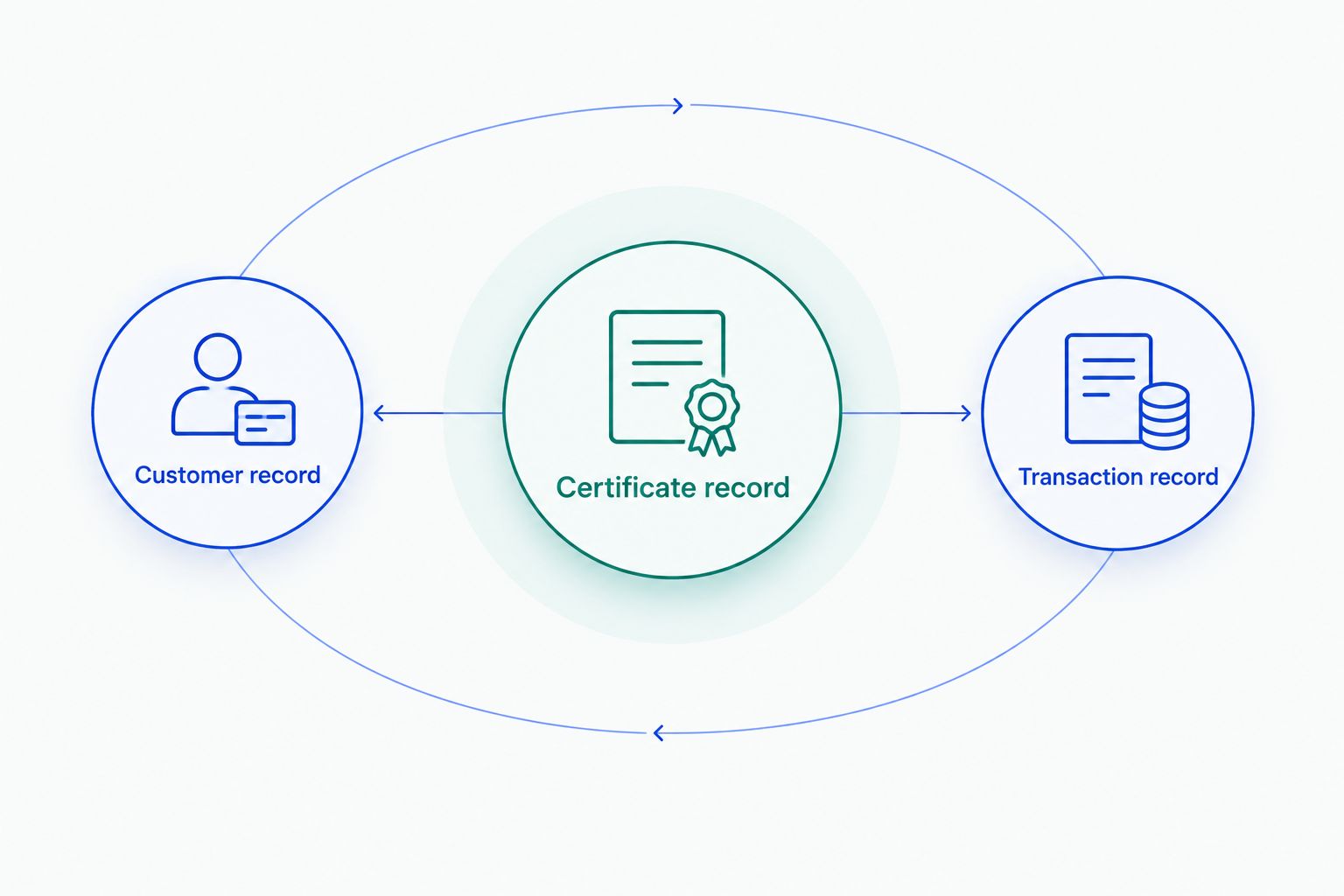
For your 2026 implementation, write the exception rules before connecting certificate status to order processing. Specify who reviews incomplete submissions, who can approve a change, and what your system does while review remains unresolved.
Test both directions. An accepted document must reach the correct customer workflow; a rejected or replaced document must not leave an unexplained exempt status behind. Treat that as an acceptance test rather than assuming the connection works because a connector exists.
Where tax tables and APIs fit
Zip2Tax is a complementary tax-rate data option for businesses that need downloadable tables or rate lookup alongside certificate management. It does not belong in this ranked certificate-management shortlist on the basis of its stated rate-data offering.
For table buyers, choose the geographic scope before the integration method. The supplied product catalog includes U.S.-wide tables, single-state tables, and a Canada GST/HST table. It also distinguishes 5-digit ZIP tables from 9-digit ZIP SalesTax+4® tables.
Those distinctions describe rate-data products. They do not establish whether a customer qualifies for an exemption, and ZIP-code length alone does not prove that a transaction has been assigned to the correct taxing jurisdiction.
Questions for downloadable table buyers
Before selecting Zip2Tax tax tables for a 2026 workflow, request the information your importer needs:
- File format: Obtain a sample and confirm column names, data types, and encoding.
- Coverage: Match the table's geographic scope to the jurisdictions your business needs.
- Effective dates: Establish how your process identifies the rates applicable to a transaction date.
- Update handling: Document how replacement files enter your system and how prior versions remain traceable.
- Import checks: Test field mapping and exception reporting before using the data in production.
Do not assume a particular file format or update schedule without confirming it. Your import specification should describe what your system needs and what the selected product supplies.
Questions for API buyers
The catalog also includes U.S. and Canada sales tax APIs. Evaluate an API when your application needs a rate request rather than a downloaded table import.
For Zip2Tax rate lookup, confirm the request fields, response fields, coverage, effective-date behavior, and error handling against the documentation supplied for the selected service. Test the connection independently from exemption handling: a successful rate response is not evidence that a certificate is valid.
How to run a useful software demonstration
Use your own documents and account structure. In 2026, a buying demonstration should follow a realistic transaction path rather than stop at an attractive certificate library.
- Collect a document. Submit a representative customer certificate through the proposed workflow.
- Review an exception. Use an incomplete or incorrectly associated submission and identify the responsible reviewer.
- Match the customer. Confirm that the certificate attaches to the intended legal customer and account.
- Apply the decision. Show how the reviewed status reaches the relevant order or accounting process.
- Retrieve the evidence. Export the record and explain the exemption treatment without relying on the live demonstration.
Include staff who handle customer requests, accounting exceptions, and technical integration. Each team sees a different failure point.
Reject a demonstration that skips unresolved cases. Routine submissions show the happy path; incomplete documents reveal whether the workflow gives staff a usable decision process.
How the shortlist is ranked
Avalara appears first as the default starting point for a dedicated certificate-management evaluation. Vertex and Sovos occupy distinct slots for buyers whose existing or proposed tax environments already involve those vendors.
This is a fit-based shortlist, not a claim that one vendor has better accuracy, faster processing, or broader verified coverage. The purchasing criteria are customer collection, jurisdiction review, customer matching, lifecycle control, audit retrieval, and system integration.
Your final ranking should follow the demonstrations. Give priority to the option that handles your difficult records, produces understandable evidence, and connects to your actual workflow. Do not substitute a familiar vendor name for an acceptance test.
Which exemption certificate software should you choose?
Start with Avalara Exemption Certificate Management if you have no existing vendor preference. Start with Vertex Exemption Certificate Manager or Sovos exemption certificate management when the corresponding vendor is already central to your tax environment.
Keep rate-data procurement separate. Choose tables or an API according to how your application consumes rates, then connect that calculation process to a documented exemption decision. Neither purchase removes the need for clear ownership of certificate review.
FAQ
What's the best sales tax exemption certificate management software in 2026?
Avalara Exemption Certificate Management is the default starting point for this dedicated certificate-management shortlist. Vertex and Sovos are relevant alternatives when those vendors already fit your tax environment; select the final option through document and integration demonstrations.
Is Vertex better than Avalara for exemption certificates?
An existing Vertex environment is a reason to evaluate Vertex first, not proof that Vertex is universally better. Compare the proposed configurations using your customer records, certificate exceptions, and retrieval requirements.
Does storing a certificate mean the sale is exempt?
No. Storing a certificate does not by itself establish that the document supports the customer, jurisdiction, exemption reason, and transaction involved. Your business needs a documented review and acceptance process.
Can Zip2Tax replace exemption certificate management software?
Zip2Tax's stated offering is tax-rate data, lookup tools, APIs, and downloadable tables, not exemption certificate management. Use rate data for calculation and a separate process for certificate collection, review, and retention.
Should I buy a downloadable tax table or use a tax API?
Choose a downloadable table when your system consumes imported rate files, and evaluate an API when your application needs rate requests. Confirm coverage, formats, effective-date handling, and integration requirements for the selected product.
Do exemption certificates always expire?
No; expiration requirements depend on the jurisdiction, certificate type, and applicable rules. Configure review and renewal procedures around those requirements rather than assigning every document the same expiration period.
What should I ask vendors to show before buying certificate software?
Ask vendors to demonstrate collection, exception review, customer matching, status handling, and evidence retrieval using your records. Confirm that the proposed configuration includes the functions and connections shown.
One last thing
Test retrieval before testing upload volume. A system can hold many documents without explaining why a particular sale received exempt treatment.
Choose a real customer and an exempt transaction. Ask your team to retrieve the supporting document, identify the applicable exemption reason, and explain the review decision. If that chain is unclear, fix the record relationships before expanding the implementation.